
From 16 Telegram Groups to an LMS: Kashuba Online on EduSystem
How a family-run online German school grew from free grammar explainers on social media into an education project with more than 700 students, original video courses and speaking clubs. And why, to keep growing, it had to leave behind dozens of Excel sheets, notebooks and manual admin work.
225 students on EduSystem, 78 migrated video lessons and the freedom to learn at your own pace. Here is how Kashuba Online is moving, step by step, from scattered tools to a structured learning system.
EduSystem is an online learning platform where schools, tutors, coaches and companies run courses under their own brand. The EduSystem team personally configures the platform around each client's workflow and supports them after launch, instead of handing over access to a ready-made template.
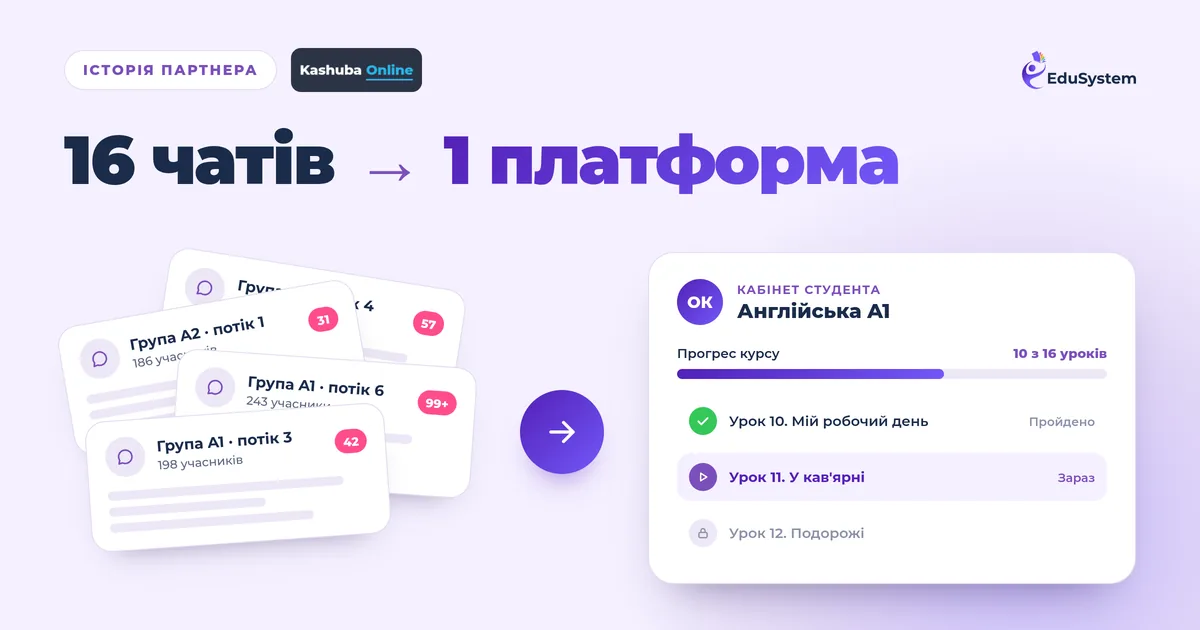
The Kashuba Online story: it all started with one question — "Why?"
Kashuba Online did not start with a business plan or an idea to open an online school. It started with a wish to understand German grammar.
After moving to Germany, Antonina Kashuba, a teacher with a background in education, began learning German herself.
Along the way she kept running into the same problem: complex grammar rules were often explained with a simple "You just have to memorise it."
"When I asked why a rule works the way it does, I was often told that German is a difficult, illogical language, so you simply have to learn it by heart.
But I can't cram. I can understand.
With my teaching background, I started looking for patterns in German grammar on my own. And I gradually realised that a lot of things that seem complicated can be explained quite logically."
Antonina started sharing the patterns she found on TikTok.
In short videos she explained grammar the way she had once wished someone would explain it to her: simply, step by step, without pointless memorisation.
The approach struck a chord with Ukrainians learning German for life, work and integration into a German-speaking environment.
Over time, a large Ukrainian-speaking community formed around the content.
TikTok was joined by YouTube, Telegram, regular free lessons and, eventually, full study programmes.
That is how the family-run online school Kashuba Online was born.
Today the school has more than 700 students, 250 of whom are already moving to EduSystem — and that number keeps growing. Kashuba Online teaches German from beginner level up to B2.
An original method: understand, don't memorise
What sets Kashuba Online apart is its original approach to teaching.
Antonina designs the course programmes herself, drawing on her own experience of learning and teaching languages.
The content meets the requirements of each language level, but the order of topics, the way they are explained and the way the material is reinforced follow her own method.
"I write the course programmes myself. Of course, there are topics you need to master at every level. But how exactly to explain them, in what order to present them and how to connect them is based on my experience.
My goal isn't for a student to simply memorise a rule. I want them to understand it and be able to apply it on their own."
That philosophy became the foundation of the school: German shouldn't feel like a chaotic set of rules. Structure the material properly, and it can be learned logically and consistently.
But as the number of students grew, a new problem appeared. The method worked and the programmes kept developing — yet the school's organisational setup gradually stopped matching its size.
Why does an online school outgrow Telegram groups, Excel and Google Drive?
Because every new cohort adds more manual work, not less: within four months Kashuba Online had 16 Telegram groups, while payments, levels and access periods were tracked in separate spreadsheets and notebooks. We broke down what this kind of "free" toolset really costs in our article on the hidden price of Zoom, cloud drives and chats.
In the early days, Kashuba Online used familiar, easy-to-access tools.
Video lessons were published on YouTube, notes and extra materials lived on Google Drive, and communication with students happened in Telegram.
Admin records were kept in Excel spreadsheets, notebooks and on paper.
The setup worked and let the school grow.
But student numbers kept rising, a new cohort started every month, and new courses and learning formats were added.
As the school grew, so did the number of organisational tasks.
Problem #1. 16 Telegram groups in four months
A new cohort of students started at Kashuba Online every month.
Each cohort got its own Telegram groups, where the school posted links to video lessons, study materials and announcements.
After just four months, the school had 16 separate Telegram groups.
And every group was at a different stage of the course.
Some students were just starting, others were finishing their first month, and some were already moving on to their third or fourth.
Meanwhile, the admin team kept several Excel spreadsheets tracking payments, levels, cohorts and access periods.
Some information stayed in notebooks or on paper.
What began as a simple solution gradually turned into a complex system of manual administration.
"At some point there were so many Telegram groups that we ourselves lost count. A new cohort started every month, and within four months we had 16 different groups.
We had to keep checking spreadsheets and keeping track of payments, access and study periods. And with every new cohort, that work got harder."
The school kept growing, but its admin system could no longer keep up.
This is a typical scenario for language schools. We looked at what breaks first when new groups and teachers appear in our article on running a language school with several teachers.
Problem #2. Students wanted to go faster or slower, but were tied to their groups
Learning at Kashuba Online followed a fixed schedule.
New video lessons came out regularly, and each cohort moved through the programme at a set pace.
Many students liked this: a clear schedule helped them stay disciplined.
But people's needs were different.
Some wanted to move faster because they had more free time.
Others found it hard to keep up because of work, family commitments or simply needing more time for grammar.
So students started asking to be moved to other cohorts.
And that created another problem.
Moving students between cohorts became a real admin headache
Every group had its own schedule.
To move a student, the team had to work out which lessons they had already completed, which materials they had paid for, what stage the other cohort was at and when exactly the switch could happen.
With no single system for tracking progress, administrators had to check everything by hand.
Even then, it wasn't always clear which group was the best fit.
"We wanted to let students learn at their own pace. But if someone fell behind and asked to switch groups, we had to figure out manually when to do it.
And if a student wanted to move faster, it was exactly the same story.
We realised that learning shouldn't depend so heavily on one group's schedule."
It gradually became clear that letting students choose their own pace was far more efficient than constantly shuffling them between cohorts.
Problem #3. Nobody could see real learning progress
Another major weakness of the old setup was that there was no way to track how students were moving through the programme.
The admin team could see who was in a Telegram group and had access to the video lessons.
But that didn't mean a student was actually studying.
There was no central way to tell whether someone had watched a lesson, was keeping to the recommended schedule, was falling behind — or, on the contrary, was ready for the next topics.
In practice, the school controlled access to materials but couldn't properly track how they were being worked through.
For Kashuba Online, where the sequence of grammar topics matters a great deal, this was a fundamental issue.
It isn't enough to give a student access to lessons; you need to understand how they are progressing through the programme.
Without that visibility, a school only finds out about a problem once the student has already disappeared. We wrote about where courses lose learners and how to spot it in time in our article on online course completion rates.
Problem #4. Video lesson links could be shared with anyone
Hosting lesson videos on YouTube was convenient in the school's early days.
But link-based access had a serious flaw: a student could pass the link on to someone else.
For a school that creates its own programmes and video lessons, this meant too little control over how its materials spread.
It needed a system that could grant personal access to purchased courses and manage how long that access lasts.
Problem #5. Students could lose access to materials they had already paid for
This became one of the most important questions when looking for a new platform.
Previously, if a student stopped studying partway through a level, they lost access to materials they had already paid for, because they left the private Telegram group — and that's where all the materials were.
For example, someone might buy the first month of study and then decide to take a break for personal reasons.
The school wanted a way to let that person return to the lessons they had paid for within an agreed period.
"It was important to us that students didn't lose materials they had already paid for. Even if they decided to pause after one month, they should still be able to come back to the lessons they bought."
In the end, the school faced a complex challenge: organise learning so that it becomes more flexible for students and easier to manage for the admin team at the same time.
How do you move an online school from Telegram groups to an LMS without losing your community?
Move the learning itself — lessons, progress and access — onto the platform, and keep Telegram for communication. That is what Kashuba Online did, so students didn't have to choose between a convenient learning dashboard and a lively community.
After analysing its pain points, Kashuba Online began looking for a platform that could bring learning materials and core course management together.
It chose EduSystem.
The goal wasn't simply to move video lessons from YouTube to another site.
The school needed a single learning environment where students get structured access to their courses, see their own progress and can study at a comfortable pace.
At the same time, the admin team needed better tools to control access and track how students move through the programmes.
Structured study programmes
Courses are organised by language level and study month.
The A1–B2 programmes are built as sequential courses of roughly 52 video lessons over four study months.
Video lessons are supported by materials for independent practice: interactive games that help grammar structures become automatic, and texts for reading.
Students get access to the relevant study period and work with all materials in one place.
Some of these tools were built by the EduSystem team specifically at Kashuba Online's request. Access to modules and lessons by language level and the Reading + Test activity arrived in release 1.5 "Structure". The Video Writing format was also created around the school's method: the student watches a video and completes a written task. And the school builds its interactive exercises in EduSystem Lab, a built-in activity builder that needs no coding.
Learning at your own pace
Moving to the platform solved the problem of being locked into a cohort.
Students can now work through the lessons available to them faster or slower, depending on their circumstances.
Those who are happy with the recommended schedule can keep following it.
Those who want to move faster or need more time get the flexibility they need.
As a result, the need to keep moving students between Telegram groups is gradually disappearing.
Tracking learning progress
One of the biggest benefits of EduSystem for Kashuba Online is being able to see student progress.
Students can now track their own progress through the course.
The admin team can also see how students are moving through the programme.
"I really love that I can see students' progress. Before, we knew that someone had been given access to the lessons, but we had almost no way of telling whether they were actually doing them.
Now we have much more information about the learning process."
Control over access to materials
Another important feature is the ability to set access periods for purchased courses.
This helps the school organise its study periods better and lets students return to materials they have already paid for within a set time.
Personal access to courses also reduces the risk of original content being shared without control.
Videos play in the protected EduSystem player: they aren't available through a public direct link, they can't be downloaded, and viewing is tied to the student's account.
Telegram stayed — but its role changed
Moving to EduSystem didn't mean giving up Telegram.
On the contrary, the Telegram community still plays an important part in learning.
Its main job now is communication, support, motivation and sharing experience between students.
The learning materials and course progress themselves are gradually moving to EduSystem.
Each tool now does its own job: EduSystem provides structured learning, and Telegram keeps the community alive.
Are video lessons enough to start speaking German?
No. At Kashuba Online, a video lesson is only the first step. It is followed by interactive exercises that make grammar automatic and by speaking clubs where a teacher checks every spoken task.
Kashuba Online combines modern technology with an original method and live practice.
The school's aim is not just to explain a grammar rule, but to teach students to use it in their own speech.
That's why the school offers several learning formats.
BASIC: learn at your own pace
BASIC is designed for students who want to learn German independently with a structured, original programme.
They get access to video lessons and study materials and can master grammar step by step at a comfortable pace.
PRO: more practice and support
PRO adds extra interactive exercises, study materials and support.
Special attention goes to making grammar structures automatic.
After all, understanding a rule and being able to use it quickly in conversation are two different skills.
That's why learning is reinforced with practical tasks that help the material stick.
Speaking clubs: from knowing the rules to real conversation
Speaking clubs hold a special place at Kashuba Online.
What makes them different is how closely they are tied to the main programme.
Students don't just work through modules on random topics — they complete spoken tasks designed to put the grammar they have already learned into practice.
Every task is checked by a teacher, and participants get feedback.
So learning follows a clear sequence: understanding grammar → independent practice → using it in real speech.
Different formats let students choose the option that fits their needs, schedule and budget.
What results did the move to EduSystem bring?
As of October 2026, 225 Kashuba Online students are studying on EduSystem and 78 video lessons have been migrated to the platform. The school now offers self-paced learning, progress tracking and managed access periods.
Kashuba Online is moving to the new platform step by step, but the school already has concrete results.
| Metric | Result |
|---|---|
| Total students at the school | 700+ |
| Moving to EduSystem in the first phase | 250 |
| Already studying on EduSystem (at the time of writing) | 225 |
| Video lessons migrated | 78 |
| Ability to track student progress | ✅ |
| Self-paced learning | ✅ |
| Managed access periods | ✅ |
| Personal access to courses | ✅ |
But the most important results go beyond the numbers.
The school can gradually move away from a complex system of separate cohorts and manual access control.
Students no longer have to fit so rigidly into one group's schedule.
The admin team can see actual learning progress, not just the fact that someone joined a Telegram group.
The school can also better protect access to its original materials and let students return to courses they have already paid for within a set period.
The main result: Kashuba Online now has tools that let it organise learning around students' needs while supporting the school's continued growth.
Antonina's review of EduSystem
Separately from this story, Antonina left a review of working with the EduSystem team on Trustpilot:
"For the first time, I felt that no one was trying to squeeze money out of me — they were genuinely invested in growing my business…"
Antonina Kashuba, founder of Kashuba Online, EduSystem community ambassador
For the first time, I felt that no one was trying to squeeze money out of me — they were genuinely invested in growing my business. EduSystem took over half our routine work and even built two custom activities just for our school.
What's next: grammar marathons and more practice
The move to EduSystem is part of Kashuba Online's broader growth strategy.
The school plans to keep adding learning materials to the platform and to expand opportunities for independent practice.
Upcoming plans include themed grammar marathons and intensives to help students work through particularly tricky topics in more depth.
The school also plans to expand its library of interactive exercises that make grammar structures automatic.
The school's main goal stays the same: to make high-quality German learning accessible, logical, consistent and comfortable for students with different abilities and learning speeds.
Conclusion: as a school grows, its system has to grow with it
The Kashuba Online story shows that growing an online school doesn't start with choosing a tech platform.
First came a teacher who refused to accept that German grammar simply has to be memorised.
Then came short TikTok explainers, free lessons, a large Ukrainian-speaking community, original courses and speaking clubs.
The school grew step by step.
But along with the number of students, the number of Telegram groups, Excel sheets and daily admin tasks grew too.
Sixteen Telegram groups in four months became a clear example of how the tools that help a school at the start can hold back its later growth.
Moving to EduSystem let Kashuba Online begin a new chapter: from scattered learning materials to a structured system where students learn at their own pace and the admin team controls access and progress.
At the same time, the school kept what makes it special: its original method, logical grammar explanations, student support and live language practice.
"I want to show people that German isn't as hard as it seems. It just needs to be structured properly and explained logically. That's what our school is built on. And EduSystem helps us make this kind of learning more convenient and accessible to more students."
Kashuba Online proves that quality learning isn't about having lots of materials — it's about organising the way they are absorbed.
And that is exactly where technology becomes the teacher's assistant, freeing them to focus on what matters most: the quality of education.
In short
Kashuba Online is a family-run online German school built on Antonina Kashuba's original teaching method, with more than 700 students. The school moved from 16 Telegram groups, Excel sheets and YouTube links to the EduSystem platform: as of October 2026, 225 students study there and 78 video lessons have been migrated.
Kashuba Online students now learn at their own pace, while the admin team sees their progress and manages access periods. Telegram stays for communication and motivation, while learning, progress and access live in EduSystem.
Is your school still running on Telegram groups and spreadsheets?
You can start the same way Kashuba Online did: gradually, with one level or cohort, without pausing teaching. Our step-by-step guide How to launch an online school: from chaos to a scalable system shows how to set up your processes from the first course, and LMS for a language school: what you need to consider covers what a language school should check before choosing a platform.
For another migration story, read how a driving school replaced its legacy LMS with EduSystem. And EduSystem pricing will show you which plan fits your number of students.
The EduSystem team will help you plan the move and set up the platform around your programme. Get in touch — we reply within 30 minutes.
Want the same for your school?
More posts live in the Blog.